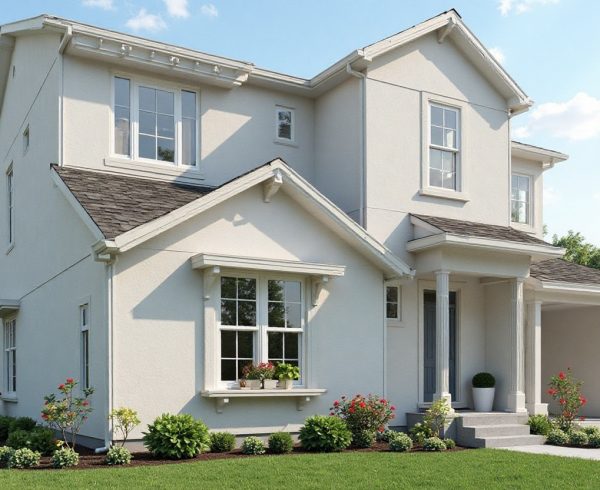
Why Elastomeric Painting Is Better Than Standard Exterior Paint
Why Elastomeric Painting Is Better Than Standard Exterior Paint
Delton, Edmonton, AB field notes for stucco, EIFS, and parging finishes under Alberta freeze-thaw cycles.
Delton weather, Alberta freeze-thaw, and why coating choice matters
Elastomeric coatings perform better than standard exterior paint on stucco and parged foundations in Delton, Edmonton, AB. The reason sits in the climate. North Central Edmonton sees rapid swings above and below zero from October to April. Surfaces get wet, then freeze, then thaw. That cycle stresses hairline cracks and weak joints. It also drives moisture into the wall system if coatings fail to bridge gaps or if they trap vapor. In T5G postal codes, these forces show up as spiderweb cracking, efflorescence, and small impact spalls on both acrylic stucco and traditional hard coat.
Depend Exteriors, a stucco contractor Delton AB residents call for envelope repairs, has tested both standard acrylic-latex house paint and elastomeric. On Delton bungalows near Delton School, and on infill builds around Eastwood and Westwood, elastomeric outlasted standard paint by several seasons. The thicker film, high solids content, and crack-bridging elastomers are clear advantages in this neighborhood’s conditions. The team sees the same pattern close to the Delton Community League, Kingsway Mall, NAIT, and Borden Park. Sheltered walls may do fine with standard paint for a time. Windward walls and foundation plinths do not.
What elastomeric paint is and how it differs from standard exterior paint
Elastomeric exterior coatings are high-build, flexible acrylic film systems. They stretch and recover as substrates expand and contract. Standard exterior acrylic-latex paint forms a thinner, less elastic film. On stucco and EIFS, that difference controls how the finish handles micro-movement across control joints, expansion joints, and hairline cracks in the finish coat.
In practice, elastomeric sits closer to a low-perm, high-elongation membrane than a paint. Many systems achieve elongation in the range of several hundred percent at break. Standard paints sit far lower. On cementitious stucco with a scratch coat, brown coat, and finish coat over galvanized wire lath, elastomeric can bridge 1/16 inch static cracks after proper prep. On EPS-based EIFS with fiberglass mesh and base coat, it resists impact checking better than thin paint, provided the base coat and mesh grade match the exposure.
Delton housing stock and wall systems that benefit most
Delton’s housing mix spans post-war bungalows, mid-century one-and-a-halfs, and modern infill duplexes. Traditional hard coat stucco dominates on bungalows along 89 Street and near Alberta Avenue. Newer infills often use EIFS for higher R-value without thick framing changes. Each system has different moisture and movement behaviors, so coating choice must reflect that.
On traditional stucco, the common issues are efflorescence, spalling at corners, and delamination in poorly keyed areas. Weak paper barriers, flashing failure at window heads, and deteriorated weep screed sections show up in older homes. On EIFS, thermal bridging at fasteners, minor impact dents, and sealant failure at terminations are more typical. Elastomeric coatings handle these differently than standard paints because they manage crack cycling better and provide a uniform film that resists bulk water.
Typical symptoms in T5G and what they signal
Stucco cracks look harmless until water reaches the scratch coat or sheathing. Hairline cracks often pattern like a spiderweb in sun-baked elevations. Bulging stucco hints at bond failure or trapped moisture. White, powdery efflorescence signals water migration through cementitious layers. Spalling indicates freeze expansion in saturated pores. Delamination suggests poor keying to the lath or incorrect mix water. Mold growth shows persistent damp pockets behind the finish. Each symptom ties back to two forces in Delton: moisture movement and thermal cycling.
Elastomeric coatings do not fix structural issues, but they reduce new water ingress across microcracks and patched areas. Standard acrylic-latex paints give color and some water shedding but lack reliable crack-bridging and weathering thickness in this climate. On elevations facing the Northlands Park wind corridor, that gap becomes costly within two or three winters.
Film build, permeability, and crack-bridging explained in jobsite terms
Three variables decide coating performance on Delton stucco. Film thickness, water vapor permeability, and elongation. Elastomeric films are thicker by design. Many systems call for two cross-rolled coats at 10 to 12 wet mils each to reach a 14 to 18 dry mils total. Standard paints often land between 3 and 5 dry mils after two coats. Thickness alone helps with pinhole resistance and uniform coverage over textured dash or sand float finishes.
Permeability needs judgment. Traditional stucco wants to “breathe” outward. EIFS depends more on managing bulk water at the finish and allowing engineered drainage behind the EPS. A low-perm elastomeric can be ideal on cracked hard coat stucco so long as the wall still vents inward or has intact weep screeds and drainage planes. On EIFS, a high-quality acrylic topcoat with elastomeric properties can work well if the base coat and mesh are sound. The target is bulk water control without trapping moisture inboard. That is why field testing with moisture meters and thermal imaging matters before coating.
Crack-bridging is the elastomeric advantage Delton homeowners can see. A good system spans static hairlines and reduces water travel across patched shrinkage cracks. Standard paint tends to break across the ridge of the crack after a few freeze-thaw cycles. Once that happens, capillary action takes water inward, and efflorescence follows on older cement finishes.
How a proper site assessment in Delton prevents coating failure
Before any coating, Depend Exteriors runs a building envelope check. The crew scans suspect areas with infrared thermal imaging on cool mornings to detect thermal anomalies that suggest moisture. They confirm with calibrated moisture meters at controlled depths in the finish coat or base coat. They inspect flashing at window heads and sills, isolate sealant failures, and check the continuity of the paper barrier or WRB where accessible. On foundations, they review parging integrity, footing splash, and downspout discharge points.
The team also looks for deteriorated backer rod and failed sealant at expansion joints and penetrations. Incorrect sealant choice accelerates water entry in winter. If a joint lacks proper backer rod diameter, the joint geometry fails. That causes three-sided adhesion and early tearing. A new elastomeric finish over a bad joint will still leak. Field experience across T5G 0B1, T5G 0C1, T5G 0H1, and T5G 0L1 shows that joint remediation is the number one step skipped by quick paint crews, and the number one reason for callbacks.
Substrate repairs that make elastomeric worth the investment
Elastomeric coatings are not a bandage over loose stucco. On traditional hard coat, loose areas get removed back to sound substrate, then re-lathed with galvanized wire lath tied to framing, not only to sheathing. The crew reinstalls proper paper or WRB laps and weep screed if missing. Scratch and brown coats are applied with correct cure times to reduce shrinkage. Where energy upgrades are planned, the team can add 1-inch EPS insulation boards, mechanically fastened as needed, to cut thermal bridging and even out planes before a new acrylic finish.
On EIFS, impact dents receive a new base coat with embedded fiberglass mesh. Corners and high-traffic zones near side yards get heavier mesh weights. Sealant removal and replacement follow manufacturer-specified primers. Penetrations receive backer rod and sealant geometry corrected to half the joint width. Where drainage is suspect, the crew opens the system to confirm an intact drainage plane.
Parging repairs matter as well. Flaking parging at grade invites splash and wicking. The team grinds back to sound cement, addresses foundation cracks if present, and reinstalls a polymer-modified parge. Elastomeric over parging helps block bulk water from vertical splash zones during spring melts along driveways and walkways common near Delton School and NAIT student rentals.
Application standards that separate a coating from a quick paint job
Quality elastomeric work reads like a small construction project, not a fast repaint. Scaffolding systems go up for safe, even coverage. Power mixers blend high-solids materials to a uniform viscosity. The crew follows wet-mil gauges to hit spec. No one guesses film build. Where overspray risks vehicles along 122 Avenue or 97 Street, the team uses shields and controlled tip sizes. Temperature and dew point spread are monitored so the film cures as intended.
On textured acrylic, the first coat is often back-rolled to drive material into valleys. The second coat crosses the first to level peaks. On cementitious finishes, primer selection matches alkalinity and porosity. On EIFS, approved topcoat systems from Sto, Dryvit, or Imasco deliver color stability that stands up to UV at south and west exposures near Kingsway Mall and Borden Park corridors.
Material systems that hold up in North Central Edmonton
Depend Exteriors works with systems from Sto, Dryvit Systems, and Imasco Minerals for mainstream projects. These names supply acrylic finishes, elastomeric topcoats, primers, and detail components that have consistent color and film integrity. For high-end builds or energy-focused retrofits, the team specifies Parex or Adex Systems EIFS packages for superior thermal performance and durable mesh assemblies. Finishes tied to AkzoNobel and BASF Wall Systems research bring reliable UV performance. On parging and cement repairs, DuRock and Senergy products integrate with elastomeric topcoats for a uniform finish.
Elastomeric versus standard exterior paint in Delton conditions
Based on field results across Delton, Eastwood, Killarney, Lauderdale, Westwood, Alberta Avenue, and Elmwood Park, elastomeric coatings produce longer intervals between maintenance cycles on stucco and parging. Standard exterior paint retains color for a time but loses crack-bridging and water shedding under freeze-thaw stress. The differences are clear by year three on most windward walls and by year five on sheltered elevations.
Key differences at a glance
Crack handling: Elastomeric bridges static hairlines. Standard paint telegraphs and splits across them.
Film build: Elastomeric runs 14 to 18 dry mils. Standard paint is often 3 to 5.
Moisture control: Elastomeric sheds bulk water better when joints are correct. Standard paint is a cosmetic barrier.
UV and color: Both can perform well with quality brands. Elastomeric keeps film integrity longer on textured stucco.
Cost and value: Elastomeric costs more upfront but reduces moisture-related repairs and repaint frequency.
Edge cases and when standard paint may be acceptable
Not every wall needs elastomeric. On smooth cement board panels with sealed joints and minimal thermal movement, a premium acrylic-latex can perform well. On wood siding elements under deep eaves along quiet Delton crescents, standard paint suffices and keeps vapor more free to escape. On EIFS where the base coat and mesh are pristine and joints are perfect, an acrylic topcoat with moderate elasticity can be fine. The decision comes down to exposure, movement, and existing moisture behavior. A short site visit near Northlands Park or along 118 Avenue can fix the choice with real measurements rather than guesses.
Components that decide success: lath, mesh, base coats, and joints
Coatings extend the life of a system. They cannot rebuild a failing assembly. On traditional stucco, sound wire lath attachment and well-bonded scratch and brown coats matter more than any paint. On EIFS, the EPS insulation board must be well adhered or mechanically fastened where required, and the fiberglass mesh must overlap at corners with the right weight for impact zones. The base coat must be thick enough to bury mesh and resist cracking before a finish goes on.
Joints deserve special attention. Expansion joints relieve movement across large walls. They need a clean backer rod sized to the joint and a compatible sealant. Without that, a high-quality elastomeric topcoat will still split at the weakest link. Weep screeds must be open and free of debris to let any incidental moisture drain. A good coating job includes these checks. That is why Depend Exteriors treats paint season like stucco season. The crew brings pneumatic staplers and mechanical fasteners to correct lath or accessory issues on the fly rather than painting over them.
Finding hidden leaks before coating saves Delton homeowners thousands
Thermal bridging around old fasteners, dark studs under thin sheathing, and wet sheathing behind failed paper barriers can hide behind a clean finish. Infrared thermal imaging will show colder bands on cool mornings. Moisture meters confirm readings at the surface and, with pin probes where applicable, deeper into the finish. If moisture is active, a standard repaint can trap it. An elastomeric coating can also trap it. The cure is to open the system where needed, repair the drainage plane, and reinstate flashing details. A quick test run near Delton School bus routes proved this on a 1950s bungalow that kept frosting in the living room corner every January. The finish looked fine. The meter told the real story. Fix the envelope first, then apply elastomeric.
Color uniformity and texture read on older stucco
Old dash finishes around Delton and Alberta Avenue vary in peak height and sand grading. Thin paint rides the peaks and leaves valleys shy of coverage. Sunlight then reveals stripes and shadow bands. Elastomeric back-rolling levels that effect, delivering a more uniform color read. On modern acrylic finishes near NAIT and Kingsway Mall, pigments from Sto, Dryvit, and Imasco hold color against UV, but substrate movement still decides film life. Elastomeric’s thicker film and flexibility carry the day on south and west exposures where heat drives movement.
Energy performance with EIFS and how coatings fit
EIFS retrofits in Delton target better R-value without deep window changes. Using EPS insulation boards at 1 to 4 inches with fiberglass mesh and a high-strength base coat, builders get continuous insulation and fewer thermal bridges. Coatings do not raise R-value, but they protect the base coat and finish against moisture and UV. Elastomeric topcoats keep hairline cracks closed and help water shed fast during spring melts. On infill projects near Westwood and Lauderdale, Depend Exteriors recommends Parex or Adex Systems EIFS for reliable thermal and impact performance. For color and surface protection, the team often finishes with Sto or Dryvit elastomeric systems, matched to the drainage and joint details on the plans.
Maintenance cycles, costs, and what Delton homeowners can expect
On a well-prepped traditional stucco wall, elastomeric systems in Edmonton conditions often hold for seven to ten years before a maintenance coat. Standard paint shows stress earlier, often at three to five years on weather sides. Costs vary by access, texture, and repair scope. Homes along busy arteries like 97 Street may need extra cleaning time due to soot. Foundations with failing parging add concrete work. Multi-storey elevations near Kingsway Mall or NAIT need more scaffolding. A short site visit and moisture check provide a clear, written range. Depend Exteriors provides free estimates and a written warranty so owners can plan on a schedule rather than react to failures after another winter.
Delton case notes from recent seasons
Near the Delton Community League, a post-war bungalow with acrylic re-coat from a decade ago showed map cracking and chalking on the south wall. Moisture readings were low. The crew primed with a high-alkali acrylic, then applied two elastomeric coats at 12 wet mils each, back-rolled to drive film into valleys. Control joints got new backer rod and a high-performance sealant. After two winters, no crack telegraphing has reappeared, and no efflorescence is present.
Close to Northlands Park, a side yard EIFS elevation took frequent ball impacts. The base coat had shallow dents and exposed mesh. The team re-meshed those zones with heavier fiberglass mesh, rebuilt the base coat, and finished with a compatible elastomeric topcoat. Standard paint would have read the dents and split at edges. Two years in, the surface remains uniform under close inspection in low-angle winter sun.
Contractor standards that align with Map Pack trust signals
Depend Exteriors operates as a licensed Edmonton contractor with WCB Alberta coverage and BBB Accreditation. Crews bring Specialized EIFS Certification to infill and retrofit work. The company backs projects with a written warranty and provides free estimates. Many clients call after seeing trucks near Delton School, NAIT, or Kingsway Mall. The team’s work also extends across St. Albert, Sherwood Park, Leduc, Spruce Grove, Stony Plain, and Devon. That footprint gives the crew real pattern recognition on how coatings age across microclimates in the capital region.
Tools and process that keep results consistent
Scaffolding systems provide safe access and allow steady pace and even film builds. Power mixers keep viscosity steady through the day. Wet film gauges verify coverage, and crews record conditions with simple logs. Pneumatic staplers and mechanical fasteners come out when lath or accessories need correction. Moisture meters and thermal imaging catch trouble before it grows. This gear exists for a reason. On a Delton corner lot that takes hard wind, the difference between a rushed repaint and a tested elastomeric system is the difference between repainting in three years and moving on to other projects for a decade.
Material specs and compatibility with stucco, EIFS, and parging
Elastomeric primers must match substrate alkalinity and porosity. On cement stucco, high-alkali primers prevent saponification. On acrylic finishes, bonding primers improve adhesion. On EIFS, finish coats must stay within manufacturer families or meet their compatibility charts. A Sto base coat pairs best with Sto finishes, a Dryvit base coat with Dryvit finishes, and similar logic follows for Imasco, Master Wall, Senergy, and DuRock. Where brand mixing is unavoidable in older homes, field adhesion tests decide. Colorants should come from stable systems, including proven AkzoNobel and BASF formulations, to reduce fade and shift on sun-exposed south and west walls across the T5G area.
Why elastomeric beats standard paint for Delton stucco
Delton faces consistent freeze-thaw loads, wind, and road splash. The building envelope benefits from thicker, flexible films that bridge static cracks and block bulk water. Elastomeric coatings deliver that function. Standard paint brings color but does not last through micro-movement. On EIFS, elastomeric helps protect the mesh and base coat. On parging, it resists splash and shedding. On traditional stucco, it slows efflorescence and reduces callouts after winter. The outcome is less rot risk at sheathing and fewer early repairs.
Quick homeowner checklist before committing to any exterior coating
Confirm a moisture scan with thermal imaging and meters, not just a visual look.
Verify joint prep: backer rod size, sealant type, and primer compatibility.
Ask for wet mil targets, film build logs, and brand data sheets.
Inspect repairs: lath reattachment, base coat rebuilds, and mesh weights.
Request a written warranty and proof of WCB Alberta and licensing.
Practical questions Delton owners ask
Will elastomeric trap moisture? It can if the wall already holds water or if drainage and joints are wrong. That is why moisture testing and joint remediation come first. With a sound drainage plane and open weep screeds, elastomeric sheds bulk water and protects the finish.
Is elastomeric worth the higher cost? On stucco and parging that see freeze-thaw and wind, yes. The longer maintenance interval and reduced water migration lower total cost. Owners near NAIT and Kingsway Mall see the value by the second winter.
What about color choices? Modern systems from Sto, Dryvit, Imasco, Parex, and Adex offer wide palettes. Depend Exteriors matches existing colors on heritage streets and suggests heat-stable tones for south and west elevations to reduce thermal cycling.
Can you coat over efflorescence? Not until the source water is addressed and salts are removed. The crew cleans, neutralizes, and fixes the leak path first. Then a primer and elastomeric finish go on.
How does this help Map Pack searches? Consistent service in T5G, documented projects near Delton Community League, and verifiable licensing and insurance signal local reliability. That is why many neighbors find Depend Exteriors when they search for a stucco contractor Delton AB.
Who does the work and why local focus matters
Depend Exteriors is a plastering contractor and EIFS specialist serving Delton and North Central Edmonton since 2004. The crews install exterior wall systems that respect heritage details and modern energy goals. They know where water runs on post-war bungalows and which infill elevations near Eastwood collect drifted snow. They also know when to leave standard paint for sheltered wood trims and where elastomeric earns its keep on stucco, EIFS, and parging.
The company’s Delton crews often install galvanized wire lath and 1-inch EPS insulation boards to strengthen the building envelope during remediation. They specialize in repairing spiderweb cracks and spalling finish coats caused by Edmonton’s aggressive freeze-thaw cycles. Using calibrated moisture meters and thermal imaging, they pinpoint water ingress behind your stucco before it causes structural rot. That is the difference between a coating job and a building envelope solution.
Service area for Delton and nearby neighborhoods
Coverage includes Delton, Eastwood, Westwood, Alberta Avenue, Elmwood Park, Killarney, and Lauderdale. The team often works along routes between Delton School, Northlands Park, NAIT, Kingsway Mall, and Borden Park. Broader service spans St. Albert, Sherwood Park, Leduc, Spruce Grove, Stony Plain, and Devon. The office tracks projects by T5G postal codes to improve response and stocking for common repairs.
Ready for a durable finish in Delton?
Elastomeric coatings protect stucco, EIFS, and parging in Edmonton’s freeze-thaw climate. They bridge hairline cracks, resist bulk water, and reduce maintenance. Standard paint cannot do that job on exposed elevations. If a home near Delton Community League or a rental by NAIT needs exterior work, a short inspection will settle the choice with data. Depend Exteriors provides a detailed, no-obligation stucco inspection and quote.
Credentials and assurances: Licensed Edmonton contractor, WCB Alberta insured, BBB Accredited, 20+ years experience, Specialized EIFS Certification, Heritage home restoration expertise, clear written warranty.
Materials: Sto, Dryvit, Imasco Minerals, DuRock, Senergy, Master Wall, with high-performance options from Parex and Adex Systems. Color stability supported by AkzoNobel and BASF Wall Systems research.
Contact Depend Exteriors for an elastomeric coating that matches Delton’s demands. Call +1 780-266-4112 or request a free estimate online. Serving the T5G area and North Central Edmonton with durable, weather-ready exterior finishes.
Depend Exteriors Stucco Repair Experts in Edmonton, AB
Depend Exteriors provides hail damage stucco repair across Edmonton, AB, Canada. We fix cracks, chips, and water damage caused by storms, restoring stucco and EIFS for homes and businesses. Our licensed team handles residential and commercial exterior repairs, including stucco replacement, masonry repair, and siding restoration. Known throughout Alberta for reliability and consistent quality, we complete every project on schedule with lasting results. Whether you’re in West Edmonton, Mill Woods, or Sherwood Park, Depend Exteriors delivers trusted local service for all exterior repair needs.